Why Your Inventory System and Sales System Don't Talk to Each Other
“Sorry, that item is actually out of stock.”
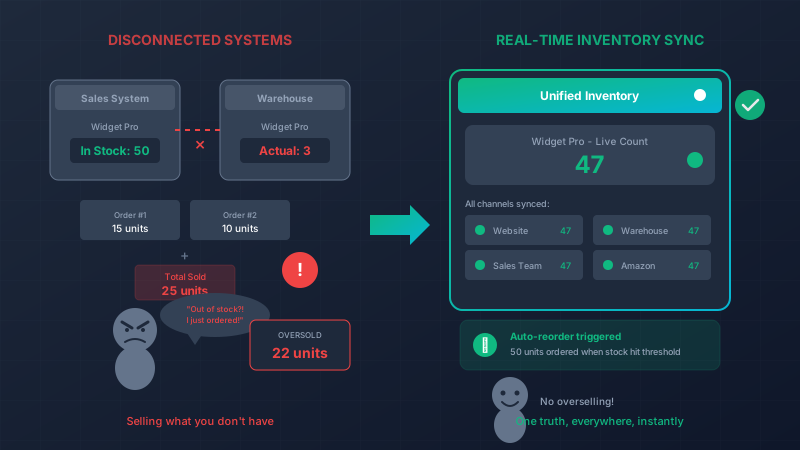
Six words that destroy customer trust. Six words that shouldn’t happen in 2025. Six words that happen every day because your inventory system and your sales system are strangers.
Your website says you have 15 units. Your warehouse says you have 3. Your sales rep just promised a customer 10. Someone is about to have a very bad day.
The Disconnect That Costs You Money
In most businesses, inventory and sales exist in parallel universes:
Sales Universe:
- CRM tracks deals and forecasts
- E-commerce platform shows “in stock”
- Sales reps check a spreadsheet (updated… last Tuesday?)
- Orders come in from multiple channels
Inventory Universe:
- Warehouse management tracks actual stock
- Purchasing manages reorders
- Receiving logs what arrives
- Shipping depletes what leaves
These universes occasionally sync—usually through a batch process that runs overnight, or worse, through manual data entry.
By the time inventory updates reach sales, reality has already changed.
The Three Painful Scenarios
Scenario 1: The Oversell
Your e-commerce site shows 20 units available. A corporate buyer orders 15. Two retail customers each order 5. That’s 25 units sold against 20 available.
Now someone has to:
- Call customers to apologize
- Offer refunds or substitutes
- Expedite emergency shipments (at premium cost)
- Deal with negative reviews
Cost: Lost revenue, damaged reputation, expediting fees, staff time managing the mess.
Scenario 2: The Stockout
Your best-selling product runs out, but nobody notices until customers start complaining. The reorder point was set at 50 units, but sales spiked and blew past it in a day. By the time purchasing places the order, you’re looking at a 3-week backorder.
Meanwhile:
- Customers buy from competitors
- Marketing is still running ads for a product you can’t deliver
- Sales reps are embarrassed in client meetings
- The restock arrives just as demand cools off
Cost: Lost sales, wasted marketing spend, customer churn.
Scenario 3: The Overstock
Sales projected big demand for a new product. You ordered 1,000 units. Sales hit 150. Now you have 850 units gathering dust, tying up cash, taking warehouse space, and slowly becoming obsolete.
Worse, the conservative forecast for your proven bestseller meant you understocked that, so you lost sales on a sure thing while sitting on inventory nobody wants.
Cost: Dead capital, storage costs, eventual write-offs.
Why Batch Updates Don’t Work
“But we sync inventory every night!”
Let’s trace what happens with nightly batch updates:
9:00 AM: Batch sync shows 50 units available 10:30 AM: Warehouse ships 20 units from yesterday’s orders 11:00 AM: Receiving logs 30 units from a PO delivery 2:00 PM: Website still shows 50, reality is 60 3:00 PM: Flash sale drives 45 orders 4:00 PM: Warehouse picks orders, realizes they now have 60 - 45 = 15, but website still shows 50 - 45 = 5 5:00 PM: 20 more orders come in against “5 available” 9:00 PM: Tomorrow’s batch runs, reveals the disaster
By the time the batch catches up, you’ve already oversold and the customer service nightmare is underway.
Batch processing treats symptoms. Real-time integration prevents the disease.
What Real-Time Integration Looks Like
With custom software, inventory and sales can exist in the same reality:
defmodule InventoryManager do
  def check_and_reserve(product_id, quantity, order_id) do
    # Real-time check and atomic reservation
    Repo.transaction(fn ->
      product = Products.get_with_lock!(product_id)

      if product.available_quantity >= quantity do
        # Reserve immediately
        reservation = create_reservation(product, quantity, order_id)
        update_available_quantity(product, -quantity)

        # Broadcast to all channels instantly
        broadcast_inventory_change(product)

        {:ok, reservation}
      else
        {:error, :insufficient_stock, product.available_quantity}
      end
    end)
  end

  defp broadcast_inventory_change(product) do
    Phoenix.PubSub.broadcast(MyApp.PubSub, "inventory:#{product.id}",
      {:inventory_updated, product.id, product.available_quantity})
  end
end
The moment someone adds to cart, inventory is reserved. Not eventually. Instantly.
Every sales channel—website, mobile app, sales rep portal, marketplace integration—sees the same number because there’s only one number.
Real-Time Inventory in Action
Here’s how Phoenix LiveView makes this visible across your organization:
defmodule InventoryDashboardLive do
  use Phoenix.LiveView

  def mount(_params, _session, socket) do
    if connected?(socket) do
      # Subscribe to all inventory changes
      Phoenix.PubSub.subscribe(MyApp.PubSub, "inventory:all")
    end

    {:ok, assign(socket,
      products: Products.with_inventory(),
      alerts: Inventory.current_alerts()
    )}
  end

  def handle_info({:inventory_updated, product_id, new_qty}, socket) do
    # Dashboard updates instantly when any change happens
    {:noreply, update_product_quantity(socket, product_id, new_qty)}
  end

  def handle_info({:low_stock_alert, product}, socket) do
    {:noreply, add_alert(socket, product)}
  end
end
Your warehouse manager sees inventory tick down as orders come in. Your purchasing team sees alerts the moment something approaches reorder point. Your sales team sees accurate availability before they make promises.
Everyone sees the same truth, at the same time.
Automatic Reorder Intelligence
Real-time data enables intelligent automation that batch processing can’t touch:
defmodule ReorderAutomation do
  def check_reorder_needs(product) do
    current = product.available_quantity
    reserved = product.reserved_quantity
    incoming = product.on_order_quantity

    # Calculate true available position
    available_position = current - reserved + incoming

    # Dynamic reorder point based on recent velocity
    velocity = calculate_sales_velocity(product, days: 14)
    lead_time = product.supplier_lead_time_days
    safety_stock = velocity * product.safety_stock_days

    reorder_point = (velocity * lead_time) + safety_stock

    if available_position < reorder_point do
      suggested_quantity = calculate_optimal_order(product, velocity)

      %{
        should_reorder: true,
        current_position: available_position,
        reorder_point: reorder_point,
        suggested_quantity: suggested_quantity,
        urgency: calculate_urgency(available_position, velocity)
      }
    else
      %{should_reorder: false, days_until_reorder: estimate_days(available_position, reorder_point, velocity)}
    end
  end

  defp calculate_sales_velocity(product, days: days) do
    Sales.units_sold(product.id, last_days: days) / days
  end
end
Instead of static reorder points that become obsolete, the system adapts to actual demand. Selling faster than usual? Reorder sooner. Seasonal slowdown? Hold off on that purchase.
Multi-Channel Synchronization
Modern businesses sell everywhere:
- Direct website
- Amazon
- Wholesale partners
- Sales rep orders
- Retail locations
Each channel typically has its own inventory number. Keeping them in sync manually is a full-time job—and it’s always behind.
defmodule ChannelSync do
  def sync_all_channels(product) do
    available = Inventory.available_quantity(product.id)

    # Update all channels simultaneously
    tasks = [
      Task.async(fn -> Shopify.update_inventory(product, available) end),
      Task.async(fn -> Amazon.update_inventory(product, available) end),
      Task.async(fn -> WholesalePortal.update_inventory(product, available) end),
      Task.async(fn -> POSSystem.update_inventory(product, available) end)
    ]

    Task.await_many(tasks)
  end
end
One inventory position, reflected everywhere, updated instantly when anything changes.
The Hidden Benefits of Integration
Beyond avoiding stockouts and oversells, real-time inventory integration enables:
Accurate Promising Your sales rep can tell a customer “Yes, we can ship 50 units tomorrow” with confidence, not hope.
Smart Allocation When inventory is tight, automatically allocate to highest-value channels or customers.
Better Forecasting Real-time sales velocity data feeds into accurate demand forecasting, not guesswork.
Cash Flow Optimization Order what you need when you need it, not safety stock “just in case” your data is wrong.
Customer Experience Accurate availability displays. Realistic delivery estimates. No disappointment emails.
The Cost of Disconnection
Let’s quantify the disconnect:
Direct Costs:
- Oversell refunds and compensation: $X per incident
- Emergency expediting: $Y per rush order
- Dead stock write-offs: $Z per year
Indirect Costs:
- Lost sales from stockouts: Often 2-4% of revenue
- Customer churn from bad experiences: Long-term compounding loss
- Staff time managing data sync: Hours per week
- Missed bulk discounts from poor ordering: Ongoing margin erosion
A mid-sized retailer we spoke with estimated their inventory-sales disconnect cost them $180,000 annually in direct costs alone—before counting lost sales and customer churn.
What Good Looks Like
Morning:
- Dashboard shows real-time inventory across all locations
- Two items flagged for reorder based on current velocity
- Purchasing reviews and approves with one click
- Orders automatically sent to suppliers
Midday:
- Flash sale drives unexpected volume on one SKU
- System automatically adjusts availability across all channels
- Alert fires when safety stock is breached
- Purchasing gets notification with suggested emergency order
Afternoon:
- Shipment arrives from supplier
- Receiving scans items in
- Available quantity updates everywhere instantly
- Website shows accurate availability for newly stocked items
End of Day:
- No oversells
- No angry customer calls
- No scrambling to find inventory that “should be there”
- Clear picture of what’s selling and what needs attention
Getting There
Connecting inventory and sales isn’t an overnight project, but it doesn’t have to be overwhelming:
-
Audit current state: Map every place inventory numbers live. Identify the gaps and delays.
-
Establish source of truth: Decide which system will be authoritative. Usually the warehouse/inventory system.
-
Build real-time connections: Start with the highest-volume channel. Prove the concept.
-
Add intelligence: Once data flows, add automated alerts, reorder suggestions, and allocation rules.
-
Expand: Connect additional channels, add forecasting, integrate purchasing.
Stop Selling What You Don’t Have
Your inventory system knows the truth. Your sales system needs to know it too—not eventually, not overnight, but right now.
Every minute your systems are out of sync is a minute you might be promising something you can’t deliver, missing a sale you could have made, or ordering something you don’t need.
The technology to fix this exists. It’s proven. It’s affordable.
Let’s talk about connecting your inventory and sales systems so you can sell with confidence, stock with precision, and never tell a customer “Sorry, that’s actually out of stock” again.
The best inventory management is invisible to customers. They just see products available when they want them and orders arriving when promised. That’s only possible when your systems share a single, real-time truth.
Live Demo: Real-Time Inventory
This interactive component demonstrates how we combine Phoenix LiveView for real-time updates with Svelte for smooth client-side interactions. Try it out – in a production app, these changes would sync instantly across all connected users.