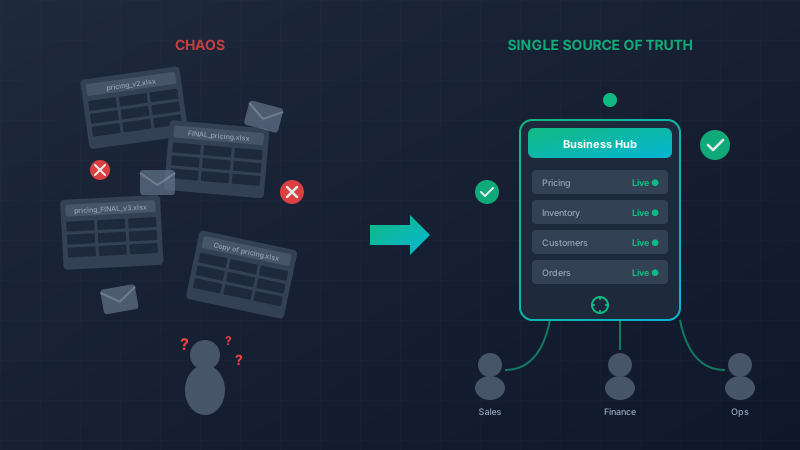
Stop Emailing Spreadsheets: Your Business Needs a Single Source of Truth
“Hey, can you send me the latest version of the pricing spreadsheet?”
“Sure, which one? I have Q4_pricing_final.xlsx, Q4_pricing_final_v2.xlsx, Q4_pricing_FINAL_FINAL.xlsx, and one Sarah sent me yesterday that might be newer.”
“I… don’t know. Whatever the sales team is using?”
“Let me check with Mike. He might have updated it last week.”
Sound familiar? Welcome to spreadsheet chaos—the silent productivity killer lurking in almost every organization.
The Spreadsheet Email Problem
Every day, millions of businesses make critical decisions based on spreadsheets that are:
- Already outdated by the time they’re opened
- Different versions in different people’s inboxes
- Manually updated (with all the errors that implies)
- Impossible to trace (who changed what, and when?)
- Locked to whoever has it open in Excel
When your business runs on emailed spreadsheets, you don’t have data—you have data fragments scattered across your organization like shrapnel.
Real Cost, Real Consequences
Let’s talk about what spreadsheet chaos actually costs:
Time waste:
- 30 minutes finding the right version
- 45 minutes reconciling conflicting numbers
- 2 hours in meetings arguing about whose data is correct
- Repeated weekly, monthly, quarterly…
Decision errors:
- Sales quotes wrong pricing (used old sheet)
- Operations orders wrong inventory quantities
- Finance reports wrong numbers to the board
- Each mistake spawns a cascade of corrections
Missed opportunities:
- By the time everyone has the same data, the window closed
- Slow decisions while waiting for “the latest numbers”
- Analysis paralysis from conflicting information
One company we spoke with traced a $200,000 pricing error back to a salesperson using a spreadsheet that was three weeks out of date. The “current” version was sitting in someone’s inbox, never forwarded to the sales team.
The Fundamental Problem: No Single Source of Truth
Here’s the core issue: spreadsheets are documents, not databases.
A document is a snapshot. The moment you email it, it starts decaying into obsolescence. Every copy becomes its own reality, diverging from every other copy.
What you need is a single source of truth—one place where the data lives, always current, always consistent, always accessible to everyone who needs it.
defmodule PricingSystem do
  # There's only ONE place pricing lives
  def get_current_price(product_id) do
    Products.get!(product_id).current_price
  end

  # When it changes, it changes for everyone, instantly
  def update_price(product_id, new_price, updated_by) do
    product = Products.get!(product_id)

    Products.update(product, %{
      current_price: new_price,
      updated_at: DateTime.utc_now(),
      updated_by: updated_by
    })

    # Notify everyone who needs to know
    broadcast_price_change(product, new_price)
  end
end
There’s no “version” to worry about. There’s no “latest file” to find. There’s just the price—current, correct, the same for everyone looking at it.
What “Single Source of Truth” Looks Like in Practice
Scenario: The sales team needs pricing information
Spreadsheet chaos approach:
- Someone maintains a master pricing spreadsheet
- They email it out whenever it changes (maybe)
- Sales people save it to their desktops (or don’t)
- Some people use the old one, some use the new one
- Nobody really knows which is authoritative
- Wrong prices get quoted, deals get messy
Single source of truth approach:
- Pricing lives in the system
- Sales opens the pricing screen—always current
- When pricing changes, everyone sees it immediately
- Audit trail shows who changed what and when
- Historical pricing available for any date
- No files to manage, email, or lose
defmodule PricingLive do
  use Phoenix.LiveView

  def mount(_params, _session, socket) do
    # Subscribe to price changes
    Phoenix.PubSub.subscribe(MyApp.PubSub, "pricing")

    {:ok, assign(socket, products: Products.list_with_prices())}
  end

  def handle_info({:price_updated, product}, socket) do
    # Everyone sees the change instantly
    {:noreply, update(socket, :products, fn products ->
      update_product_in_list(products, product)
    end)}
  end
end
The salesperson checking pricing at 2:47pm sees the same price as the salesperson checking at 2:48pm—even if it changed at 2:47:30pm. Real-time. Consistent. Trustworthy.
Beyond Pricing: Where This Pattern Applies
Spreadsheet chaos isn’t limited to pricing. We see it everywhere:
Inventory levels: Warehouse has one number, sales has another, purchasing has a third. Nobody knows what’s actually in stock.
Customer information: Contact details in three different spreadsheets, all slightly different. Which phone number is current?
Project status: PM has one version of the timeline, executives have another, clients were sent something different entirely.
Employee directory: HR has the master, but it was last emailed out six months ago. New hires aren’t on anyone’s list.
Commission calculations: Sales thinks they’re owed $X, finance calculated $Y, and the spreadsheet logic is so complex nobody can audit it.
Budget tracking: Department heads track spending in their own spreadsheets. Finance consolidates monthly. Nothing reconciles cleanly.
Every one of these can be solved with a centralized system that becomes the single source of truth.
The Collaboration Multiplier
When everyone works from the same data, something powerful happens: collaboration becomes natural.
defmodule InventoryDashboard do
  use Phoenix.LiveView

  def mount(_params, _session, socket) do
    Phoenix.PubSub.subscribe(MyApp.PubSub, "inventory")

    {:ok, assign(socket,
      inventory: Inventory.current_levels(),
      recent_changes: Inventory.recent_activity(),
      low_stock_alerts: Inventory.below_threshold()
    )}
  end

  def handle_info({:inventory_change, change}, socket) do
    # Warehouse updates quantity -> Everyone sees it live
    {:noreply,
      socket
      |> update(:inventory, &apply_change(&1, change))
      |> update(:recent_changes, &[change | Enum.take(&1, 9)])
      |> update(:low_stock_alerts, fn _ -> Inventory.below_threshold() end)}
  end
end- Warehouse receives shipment → inventory updates instantly
- Sales sees updated availability → makes accurate promises
- Purchasing sees the same numbers → orders appropriately
- Finance sees movement → forecasts accurately
No phone calls asking “what’s the real number?” No emails requesting “the latest spreadsheet.” No meetings to reconcile conflicting data. Everyone just knows because they’re all looking at the same thing.
The Audit Trail You’ve Always Needed
Spreadsheets have no memory. When someone changes a number, the old number is gone. Want to know what the price was last Tuesday? Good luck.
A centralized system can track everything:
defmodule AuditLog do
  def log_change(entity, field, old_value, new_value, user) do
    %AuditEntry{
      entity_type: entity.__struct__,
      entity_id: entity.id,
      field: field,
      old_value: to_string(old_value),
      new_value: to_string(new_value),
      changed_by: user.id,
      changed_at: DateTime.utc_now()
    }
    |> Repo.insert!()
  end

  def history_for(entity) do
    Repo.all(
      from a in AuditEntry,
      where: a.entity_type == ^entity.__struct__ and a.entity_id == ^entity.id,
      order_by: [desc: a.changed_at]
    )
  end
end
Now you can answer questions like:
- “What was the price on March 15th?” → Instant answer
- “Who changed the customer’s address?” → Name and timestamp
- “When did we run out of Product X last quarter?” → Full history
- “What did this budget look like before the revision?” → Complete trail
For compliance, for troubleshooting, for accountability—the history is always there.
Making the Transition
“But we’ve always used spreadsheets” is the most common objection we hear. Here’s how to make the shift:
Start with one pain point. Don’t try to eliminate all spreadsheets at once. Pick the one causing the most problems:
- The pricing sheet that’s always out of date
- The inventory tracker that never matches reality
- The customer list that’s impossibly fragmented
Build a simple, focused solution. It doesn’t need to do everything Excel does. It needs to do your specific thing reliably:
- Show current data
- Allow authorized updates
- Keep everyone in sync
- Maintain history
Run parallel briefly, then commit. Use both systems for a week to build confidence. Then make the new system authoritative. Delete the spreadsheets. (Yes, actually delete them. Otherwise people will keep using them.)
Expand from there. Once you’ve proven the concept with one workflow, the next one is easier. And the next. Eventually, spreadsheets become the exception, not the rule.
The Features That Matter
When we build centralized systems, these capabilities prove most valuable:
Real-time synchronization
# When data changes, everyone sees it immediately
Phoenix.PubSub.broadcast(MyApp.PubSub, "inventory", {:updated, item})
Role-based access
# Sales can view pricing, only managers can change it
def can_update_price?(user), do: user.role in [:admin, :pricing_manager]
Validation rules
# Catch errors before they become problems
def validate_price_change(changeset) do
  changeset
  |> validate_number(:price, greater_than: 0)
  |> validate_change(:price, &within_allowed_range?/1)
end
Search and filter
# Find anything instantly
def search_products(query) do
  Products.search(query, [:name, :sku, :description])
end
Export when needed
# You can still get a spreadsheet when you actually need one
def export_to_csv(products) do
  # But it's a report FROM the source of truth, not THE source of truth
end
The ROI Conversation
Let’s put numbers to this:
Time savings:
- 5 employees × 3 hours/week wrangling spreadsheets = 15 hours/week
- 15 hours × $40/hour × 50 weeks = $30,000/year
Error reduction:
- 2 significant errors per month from bad data
- Average cost per error: $5,000 (conservative)
- 24 errors × $5,000 = $120,000/year
Decision speed:
- Faster decisions from reliable data → hard to quantify
- But ask yourself: what’s a week of delay worth?
A custom system to centralize your critical business data might cost $20,000-50,000 to build. It often pays for itself in the first year.
What You Gain
When spreadsheet chaos ends, you get:
✅ Confidence in your data – The number is the number. Period.
✅ Faster decisions – No waiting to verify which version is correct.
✅ Better collaboration – Everyone working from the same playbook.
✅ Complete history – Know what changed, when, and why.
✅ Reduced errors – Validation catches mistakes before they spread.
✅ Time back – Hours previously spent on data wrangling, now available for actual work.
The Turning Point
There’s a moment in every growing business when spreadsheets stop scaling. You’ll know you’re there when:
- You have more than 3 people regularly updating the same data
- You’ve had a costly error traced back to version confusion
- You spend more time managing spreadsheets than using the data in them
- You’ve ever said “I don’t trust these numbers”
That’s the moment to build something better.
Ready for a Single Source of Truth?
Your business deserves better than a patchwork of spreadsheets held together by email threads and good intentions.
One system. One version. One truth.
Let’s talk about which spreadsheet is causing you the most pain. We’ll help you design a centralized solution that everyone can trust—and that you’ll never have to email around again.
The goal isn’t to eliminate spreadsheets entirely. They’re great for ad-hoc analysis and personal calculations. The goal is to stop using them as the system of record for data that multiple people depend on. That job requires a real system.
Live Demo: Real-Time Inventory
This interactive component demonstrates how we combine Phoenix LiveView for real-time updates with Svelte for smooth client-side interactions. Try it out – in a production app, these changes would sync instantly across all connected users.